
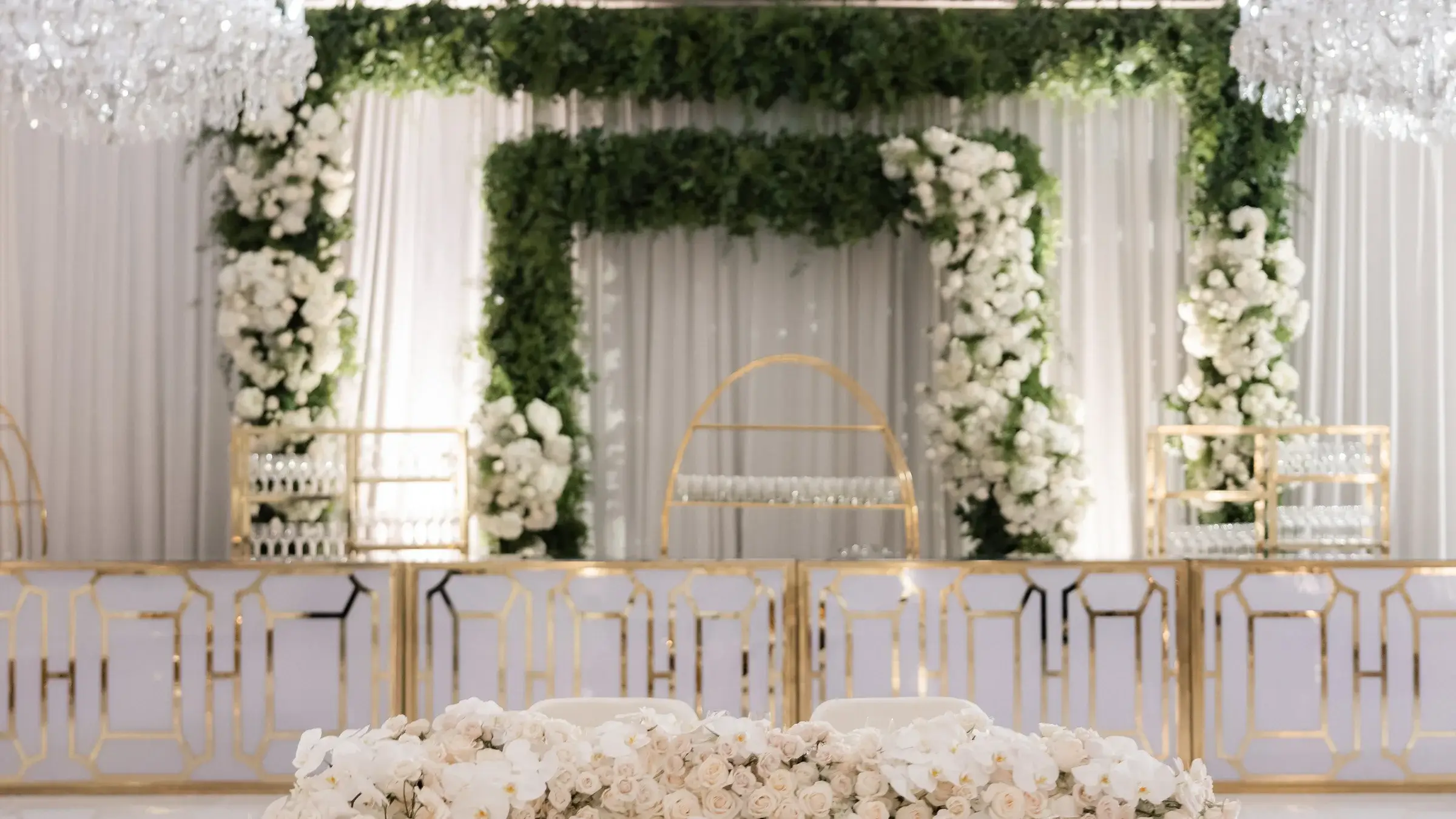
Event Draping · Los Angeles
Event draping and pipe and drape in Los Angeles.
Backdrops, perimeter draping, room dividers and service-area screening — installed and struck by our crew, planned around what the room needs rather than sold by the panel.
What it does
Event draping for weddings and private events
Most venues are not designed for your event. They are designed to host many different events, which usually means neutral surfaces at best and actively unhelpful ones at worst — a dated wall behind where the ceremony has to go, a bank of doors beside the head table, a room twice the size the guest count needs.
Draping is the fastest way to fix that, because it changes the surfaces rather than adding to the floor. A wall that was competing with the design disappears behind fabric. A hall that felt cavernous becomes a room. A ceremony gets a background that was chosen rather than inherited.
We provide draping as an installed service — assembled on site, planned around the venue’s load-in window, and removed after the event. It is a production element handled by a crew, not a box of poles left at the door.
Applications
Where draping is used
Ceremony & stage backdrops
A clean fabric backdrop behind a ceremony, a head table or a stage gives the focal point of the room a deliberate background instead of whatever the venue happens to have there. It is the single most photographed surface at most weddings, which is why it is usually the first place draping goes.
Perimeter & venue wall draping
Running fabric along the walls of a space changes the entire character of a room in a way that no amount of centrepiece work can. It is most valuable in venues fighting a specific problem — dated wall finishes, mismatched surfaces, doors and fixtures that pull the eye away from the design.
Room dividers & space shaping
A single large hall can be divided into a ceremony space and a reception space, or a room that is too big for the guest count can be brought down to a size that feels full rather than empty. Draping does this without construction, and it comes back out at the end of the night.
Service-area & production masking
Catering staging, prep areas, storage, back-of-house traffic, cases and cabling all have to exist somewhere. Screening them keeps the working side of an event out of the guest experience, which matters most in venues where there is no natural back-of-house.
Entrances & reveals
Draping can create an entrance where the room does not have one, or hold a space closed until a moment in the timeline. A reveal only works if the thing being revealed was genuinely hidden beforehand, and fabric is the most practical way to do that in a temporary space.
Better together
Draping and lighting
Fabric and light belong in the same conversation. A draped wall is a far better surface to light than bare architecture — it is even, it has no fixtures or doors interrupting it, and colour reads consistently across its whole length. Uplighting a draped perimeter produces the deep, saturated look people picture when they imagine a transformed ballroom, and it is very difficult to achieve on a plain wall.
That is why we plan the two together. See uplighting rental for the room colour, event lighting for the broader design, or pin-spot lighting if there are specific features in front of the drape that need to stay visible once the room dims.
Planning
Delivery, installation and removal
Draping is one of the more time-sensitive elements at an event, because it usually has to be up before anything else can be set against it — tables, staging, florals and lighting all follow it. That makes the load-in window the first practical question rather than an afterthought.
We plan installation around the venue’s access, coordinate with whoever is setting the room, and strike afterwards. If draping is part of a larger booking with AV equipment rental or full event production, it is sequenced into the same schedule rather than run as a separate delivery.
Draping also appears alongside staging and scenic elements — see staging and scenic design for risers, decking and structural work, or event rentals in Tarzana for local Valley bookings.
Los Angeles & Southern California
Event draping rentals in Los Angeles
We provide event draping across Los Angeles and the surrounding region for weddings, private events, corporate programmes and venue work. Because every room is different, we scope draping from a floor plan and the load-in details rather than from a package size.
Tell us what you want the draping to achieve — a backdrop, a divider, a perimeter, or screening a working area — and we will come back with what the room actually needs.
Pipe and Drape Rental in Los Angeles
Pipe and drape is the system behind most of what you see here: uprights and adjustable crossbars carrying panels of fabric, assembled to the width and height a room needs. It is what hides a service corridor, turns an unfinished wall into a clean backdrop, forms a photo wall, or divides one large hall into a ceremony space and a reception space that guests never see at the same time. Because the hardware is adjustable, a pipe and drape rental is quoted by the run length and finished height rather than sold in fixed kits — and we install and remove it, since the difference between drape that looks intentional and drape that looks like a partition is almost entirely in the hanging.
Watch
Behind the scenes and on the night
FAQ
Event draping questions
What is event draping?
Event draping is fabric hung on temporary supports to change how a room reads — covering a wall you would rather not see, creating a backdrop behind a ceremony or a stage, dividing a large space into smaller ones, or screening off a service area. It is one of the fastest ways to make a plain or awkward room look designed, because it changes the surfaces rather than adding objects to the floor.
What is pipe and drape?
Pipe and drape is the standard hardware approach: weighted bases (the "pipe and base" part), uprights and horizontal supports carrying fabric panels, assembled on site and removed afterwards. It is free-standing, so it does not depend on the venue's walls or rigging points, which is what makes it work in ballrooms, tents and raw spaces alike.
What can draping be used for at a wedding?
Ceremony backdrops, head-table and sweetheart-table backdrops, entrance reveals, softening a plain ballroom wall, dividing a single room between ceremony and reception, and screening catering or service areas from guest view. It is often the difference between a venue that looks like a hall and one that looks like a designed space.
Can draping cover an entire room?
Perimeter draping — running fabric along the walls of a space — is a common request, particularly in venues where the existing walls work against the design. Whether full perimeter or selected walls makes more sense depends on the room, the sightlines and where guests will actually be looking. We scope it from the floor plan.
Do you install the draping?
Draping is provided as an installed service. It is assembled and set on site and removed after the event, planned around the venue's load-in window and access rather than dropped off for someone else to put together.
Can draping be lit?
Yes, and it is usually worth doing. Fabric is one of the best surfaces at an event for taking colour — uplighting a draped wall produces a far cleaner wash than lighting bare architecture, because the surface is even and the colour reads consistently along it. Draping and lighting are frequently planned together for that reason.
Does draping work in tents and outdoor spaces?
Tents are a common application, since fabric structures often benefit from interior draping to soften the space or to screen off working areas. Outdoor and non-traditional spaces vary more, because wind, anchoring and ground conditions all bear on what is appropriate — those are assessed for the specific site.
What do you need to know to quote draping?
The venue and city, the date, what you want the draping to achieve — backdrop, divider, perimeter, screening — and roughly how much length or wall you want covered. A floor plan or photos of the room help more than anything else, along with the load-in and load-out windows.
Ask About Draping
Tell us the venue, the date and what you want the draping to do — a floor plan or photos of the room help most.