
Planning Guides
The Hora and the Chair Lift at a Jewish Wedding: Timing, Music, and How to Get It Right
What the hora is, when it usually happens, how chair lifting fits in, how long the moment commonly lasts, and how DJ and MC timing makes or breaks it — with the caveat that customs vary by family.
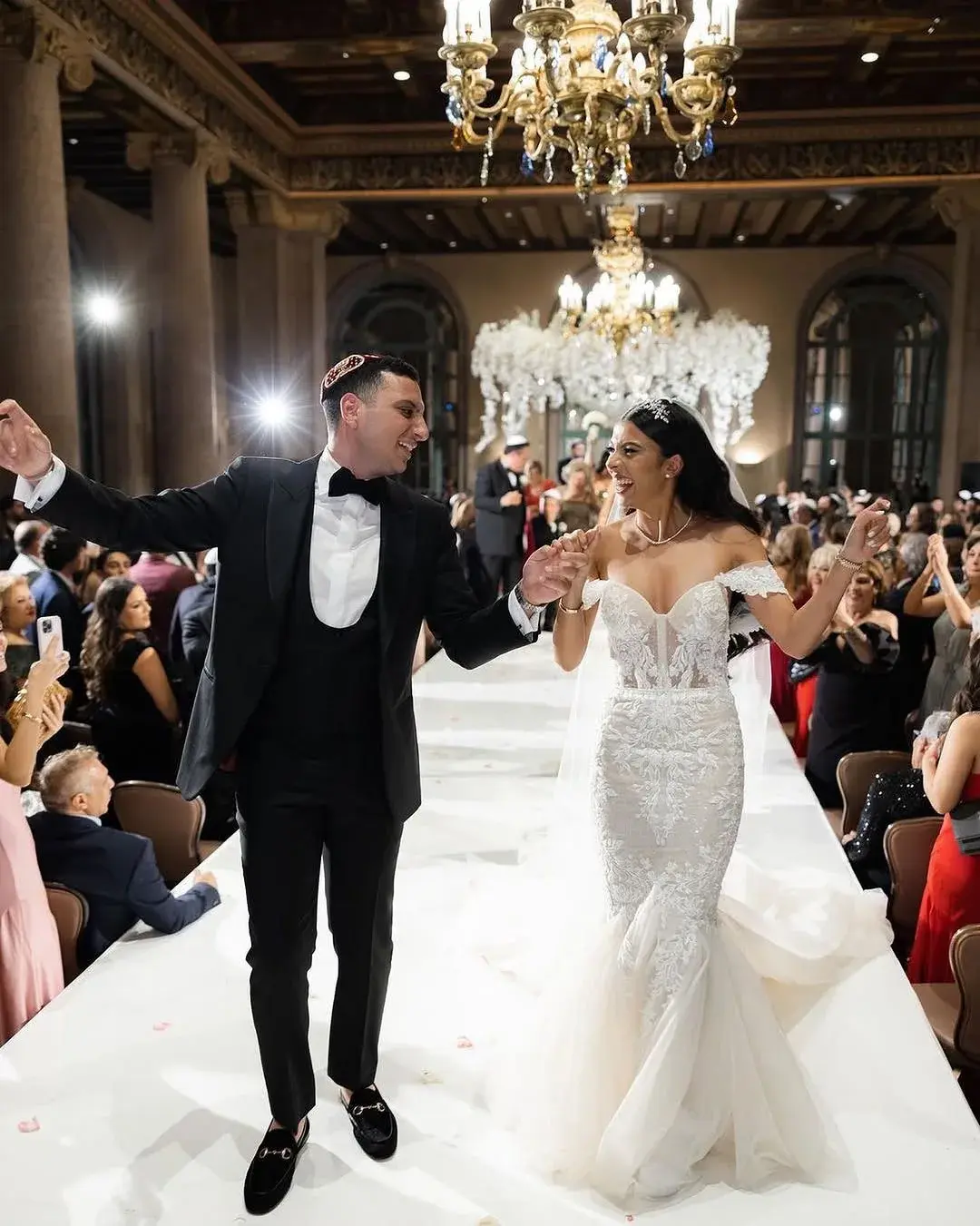
What the hora is
The hora is the circle dance that, at many Jewish weddings, becomes the emotional high point of the reception. Guests join hands and dance in rings around the couple — often several concentric circles moving in opposite directions — while the music builds. It is joyful, physical, and communal, and it commonly gathers more of the room onto the floor than any other moment of the night.
The chair lift is the part most people picture: the couple (and, depending on family tradition, their parents) hoisted on chairs above the crowd, often holding a napkin or cloth between them. It is not a separate event so much as the peak of the hora — the point the whole dance builds toward.
When it usually happens
At most Jewish weddings we produce in Los Angeles, the hora happens early in the reception — commonly right after the grand entrance, before dinner service, while the room is still full and everyone is standing. Some couples place it after the first course, and a few families prefer it later; there is no single correct time. What matters is that it happens while energy is high and the whole room is present.
The practical reason for an early hora is simple: it is the one dance where you want grandparents, kids, and every table on the floor together. Once dinner has been served and the room has settled, that becomes harder to recover.
How chair lifting typically fits into the reception
A well-run hora has a shape. It commonly opens with the whole room in circles, builds through two or three songs, and then transitions into the lift — the couple raised first, then, depending on the family, parents and sometimes siblings or grandparents. After the lifts, the circles often re-form for one more high-energy stretch before the MC guides guests to their seats.
Because customs vary, we ask every couple in advance: who is being lifted, in what order, and whether the parents want to be lifted at all. Some families lift only the couple; some lift both sets of parents; some skip the lift entirely and keep the circles going. There is no default — there is only what your family wants.
How long the moment commonly lasts
In our experience a full hora — circles, lifts, and the finish — commonly runs somewhere around eight to fifteen minutes. Shorter feels rushed; much longer and the lifts become physically hard on the people doing the lifting. A good DJ shapes the length by reading the floor rather than watching a clock: the music builds while the energy climbs and resolves once the lifts are done.
Safety and coordination
The chair lift is the one wedding moment where coordination is a safety matter, not just a musical one. We brief the lifters in advance — usually groomsmen, brothers, or close friends — on stable grip and a smooth lift-and-lower, and the MC cues the lift verbally so it happens together rather than one side going up first. Sturdy, armless chairs matter, and so does clearing the immediate floor of anything a lifter could trip on. Photographers and videographers are told the timing so they are in position rather than in the way.
The music buildup
The hora is built, not played. Depending on the family, the set commonly moves through traditional simcha songs into higher-energy Israeli and Hebrew dance music, with the tempo and intensity rising toward the lift. Persian-Jewish and Sephardic families often want the Hebrew catalog woven with their own music; Israeli families frequently lean on current Israeli hits and Mizrahi favorites. Rather than one fixed playlist, we build the arc around the couple's requests and the room in front of us.
How DJ and MC timing affects the moment
The difference between a hora that people talk about for years and one that fizzles is almost always timing. The MC has to bring the room to the floor decisively, the DJ has to lift the energy in step with the circles, the lift has to be cued cleanly, and the whole thing has to resolve before it drags. That is coordination between two people who have done it together many times — which is one reason we run our own DJ and MC as one team rather than pairing strangers on the day.
Differences across families and traditions
Ashkenazi, Sephardic, Mizrahi, Persian-Jewish, and Israeli families often approach the hora — and the whole reception — differently, and no two weddings we produce are the same. Some families keep men and women in separate circles; some do not. Some lift many family members; some lift only the couple. Some want the hora to open the dancing and flow straight into the party; some want it as its own set piece. The best approach is a conversation before the wedding, not an assumption on the day.
Planning a Jewish wedding in Los Angeles?
We have produced Jewish, Israeli, and Persian-Jewish weddings across Los Angeles since 2009 and build the hora around your family's customs. See how we approach the whole night on our Jewish wedding DJ page, and if your celebration leans Israeli or includes a mitzvah down the line, we produce those too.