
Planning Guides
Projector vs. LED Wall for Events: How to Choose the Right Display in Los Angeles
Both can look great and both have real limitations. An honest comparison of projection and LED walls for events in Los Angeles.
How they work
One of the most common questions when planning an event in Los Angeles — whether it is a wedding, a corporate conference, or a bar mitzvah — is whether to rent a projector and screen or an LED video wall. Both can look great. Both have real limitations. The right answer depends on your venue, your budget, and what you are trying to accomplish.
A projector throws a beam of light at a surface: a screen, a wall, or a floor. The image quality depends on the projector's brightness (measured in lumens), the ambient light in the room, and the throw distance from projector to screen.
An LED wall is a self-lit modular display made up of individual LED panels. Each pixel generates its own light. There is no projection involved — the image comes directly from the wall. That fundamental difference explains most of what follows.
When a projector is the right choice
Controlled lighting environments. A dark ballroom, a blackout-curtained conference room, a dinner setting with low ambient light — projectors work well here. When you can control the light in the room, a quality projector produces a large, crisp image at a lower cost than an LED wall.
Smaller events and presentations. A 100-person corporate meeting with a standard presentation, or a wedding ceremony where a monogram is projected on a wall, does not usually need an LED wall. A projector handles both well in the right conditions.
Gobos and gobo projection. Gobo projectors throw a pattern or monogram through a metal stencil onto a surface. This is a separate product from standard presentation projectors and is used for logos, names, and decorative patterns on walls, floors, and ceilings. LED walls do not do this.
Aerial projection and mapping. Projection mapping — projecting onto three-dimensional objects, buildings, or irregular surfaces — requires projectors. LED walls are flat panels.
Budget-constrained events where the lighting situation is cooperative. Projectors and screens are generally less expensive than LED walls for comparable display area.
When an LED wall is the right choice
Any venue with ambient light you cannot fully control. Windows, skylights, open tent sidewalls, outdoor afternoon events — ambient light destroys a projected image. LED walls are self-lit and bright enough to hold their image in bright conditions.
Video production and livestreaming. Cameras pick up projected images poorly, showing banding, washout, or moiré patterns depending on the camera shutter speed and the projector refresh rate. LED walls reproduce cleanly on camera. If your event is being recorded or streamed, an LED wall is almost always the better choice.
Large venues and long viewing distances. A projector requires a throw distance and a screen surface. In a large room, a very large screen requires either a very long throw distance or a short-throw lens. LED walls can be configured to many sizes and do not need projection space.
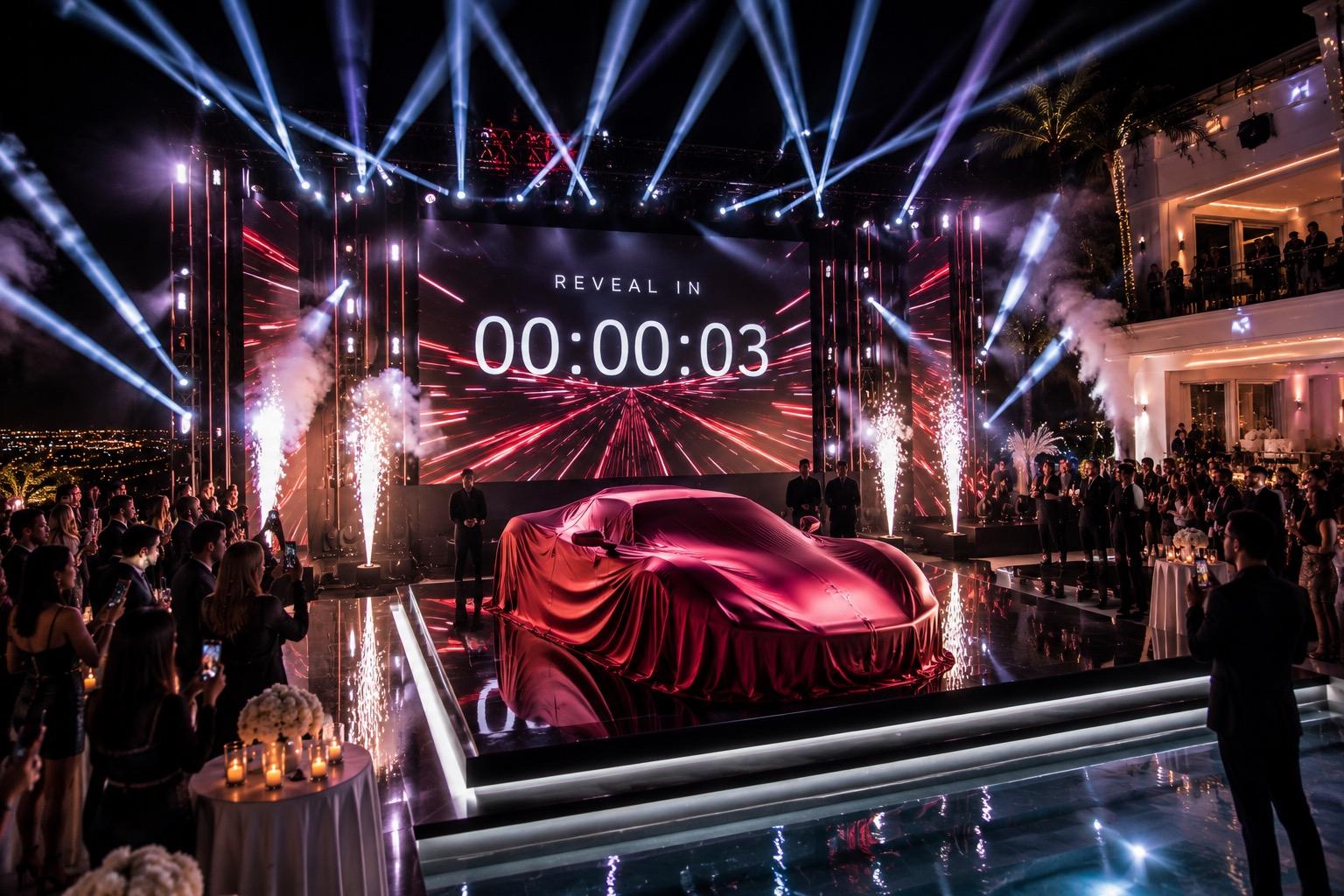
Main stage backdrops. A full-stage LED backdrop changes the entire feel of a room in a way a projection screen cannot. The image is vivid, uniform, and visible from every angle. This is why LED walls dominate concert stages, broadcast studios, and high-production events.
Events where the display is a design element. LED walls can be shaped, curved, or arranged creatively, and can display video, animations, brand content, and live camera feeds. A white projection screen is a functional tool; an LED wall is a production element.
The hybrid: projection on a non-traditional surface
Sometimes the answer is not either/or. Projection onto a circular ceiling, a voile drape, a fabric scrim, or a three-dimensional set piece is a design choice that neither a flat screen nor a standard LED wall can replicate. Discuss your creative goals with your AV vendor before defaulting to one or the other.
Side-by-side comparison
The trade-offs in short form:
| Factor | Projector + Screen | LED Wall |
|---|---|---|
| Ambient light resistance | Low — requires a dark room | High — works in daylight |
| Camera and livestream quality | Poor (washout, moiré) | Excellent |
| Large-format brightness | Limited by lumens | Very high |
| Setup complexity | Moderate | Higher |
| Typical cost | Lower | Higher |
| Content flexibility | Slides, video, static | Video, live feeds, animations |
| Custom shapes and sizes | Screen size is fixed | Modular — many configurations |
| Gobo and monogram projection | Yes (specialty gobos) | No |
What we see most often in Los Angeles
For weddings in hotel ballrooms: LED walls on the main stage or chuppah backdrop, with projectors used for ceremony monograms or gobo lighting on the ceiling and walls.
For corporate events: LED walls for keynote stages and main presentations, projectors for breakout rooms and smaller sessions.
For bar and bat mitzvahs: LED walls for the main party hall, because the visual impact matters and rooms are rarely dark enough for reliable projection.
For outdoor daytime events: LED walls. Projection in daylight does not work.
Getting the right equipment for your event
DJ Next Level provides both projector rentals and LED wall rentals for events across Los Angeles. We have been doing this since 2009, equipment is owned and operated in-house, and we will give you a straight answer on which option makes more sense for your specific event — not whichever one costs more.