
Planning Guides
Uplighting vs. Pinspotting: What's the Difference for Weddings & Events?
Uplighting colors the room; pin spotting makes the details pop. Here's what each actually does, a side-by-side comparison, when to choose one or both, and the real numbers we use when we light a Los Angeles ballroom.
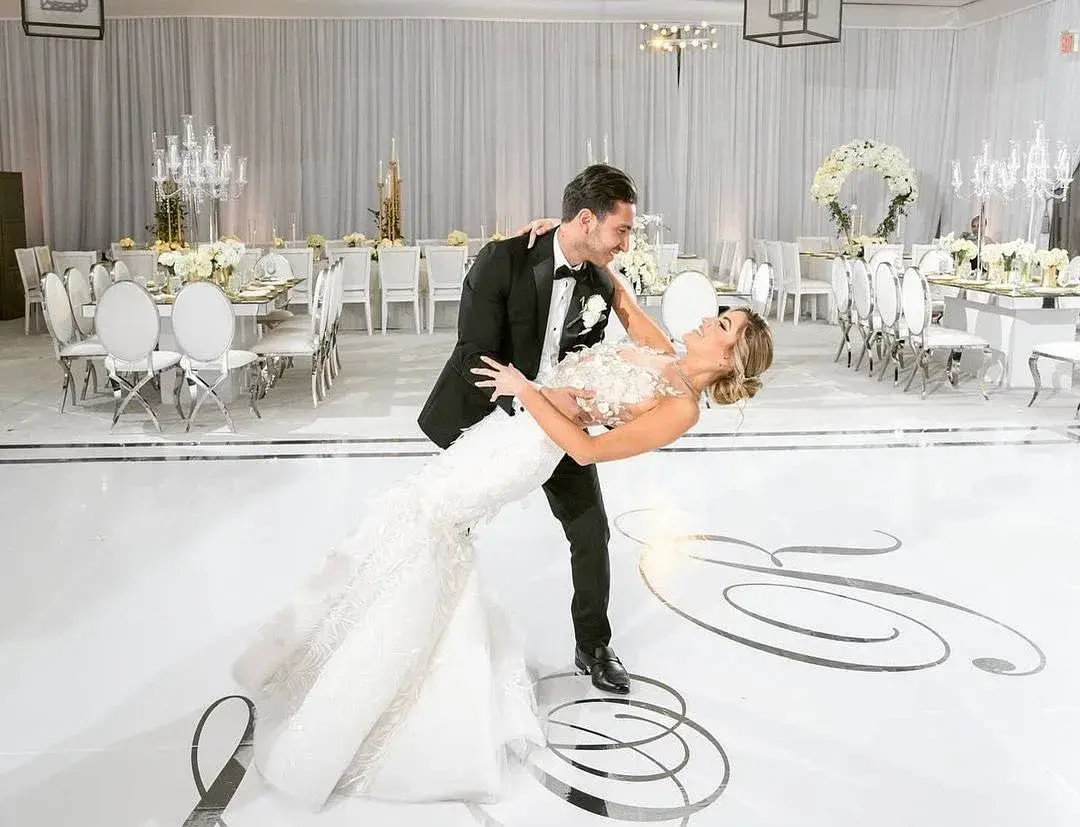
The decision most couples and planners actually face
Almost every lighting conversation we have starts the same way: "we want the room to feel warmer and more elegant — do we need uplighting, pin spots, or both?" They are the two most-requested lighting elements at Los Angeles weddings and events, they solve completely different problems, and they are often confused for each other. This guide explains what each one does, when to use which, and what happens when you combine them — with the real numbers we work from.
What uplighting does
Uplighting is color and atmosphere. Fixtures placed on the floor along the perimeter of the room throw a wash of light up the walls, columns, and drapery, so the whole space takes on your palette — soft amber and champagne through dinner, saturated color once the dance floor opens. It is what makes a plain ballroom feel like it was designed for your event, and it is the single most transformative thing you can do to a room for its cost.
Our uplights are wireless and battery-powered, so there are no cables taped across the venue floor and no outlet hunting. Because they are programmed on our grandMA3 control, the color can shift through the night — warm for the ceremony and dinner, then a deeper tone or a slow color change when the party starts — instead of sitting on one static color all evening.
What pin spotting does
Pin spotting is precision. A pin spot is a very narrow, focused beam aimed from above at a single object — a centerpiece, the cake, the sweetheart table, a floral installation — so it stands out in the room and photographs beautifully instead of disappearing under dim ambient light. Where uplighting washes the walls, pin spotting picks out the details you paid a florist and a designer to create.
The craft is in the aiming. We focus each pin spot on-site after your tables and centerpieces are fully dressed, coordinated with your florist, caterer, and planner, so the beam lands cleanly on the arrangement rather than spilling onto the tablecloth or into a guest's eyes.
Uplighting vs. pin spotting, side by side
The quickest way to see the difference is next to each other:
| Uplighting | Pin spotting | |
|---|---|---|
| Purpose | Sets the mood and color of the whole room | Highlights specific objects and details |
| Where it goes | Floor level around the perimeter, aimed up at walls, columns, and drape | Overhead (truss, rigging points, or stands), aimed down at tables and features |
| What it lights | The architecture and the room's envelope | Centerpieces, cake, head or sweetheart table, floral and décor features |
| Beam | A wide wash | A tight, narrow spot |
| Indoor vs. outdoor | Both — battery fixtures work on lawns and in tents | Mostly indoor or tented; needs an overhead position and a controlled ambient light level |
| Best for | Any event where the room itself needs to feel designed | Dinners and receptions where centerpieces and the cake are part of the design and need to photograph |
| In photos | Gives the wide shots color and depth | Gives the detail shots their glow |
When to choose each
Choose uplighting first when the room is the problem — a plain hotel ballroom, a white tent, a venue whose house lighting is flat or unflattering. It fixes the space. It is also the right single element for corporate events, mitzvahs, and dance-floor-driven receptions where atmosphere matters more than table detail.
Choose pin spotting when the details are the point — a floral-heavy dinner, tall centerpieces, a designed cake table, a sweetheart table you want to glow. If the room lights are dimmed for ambience (which they should be for a great dance floor), your centerpieces go dark without it. Pin spotting is what lets you dim the room and keep the design visible.
Using both together — what it looks like in a real room
In practice, most of the weddings we light use both, because they answer different questions. A typical Los Angeles ballroom of 150 to 250 guests gets uplighting around the full perimeter so the walls carry the palette, and pin spots on each guest table centerpiece plus the cake and head table so the design reads once the room dims. Through dinner the uplighting sits warm and the pin spots do the work; when the dance floor opens, the uplighting shifts to a saturated color, dance-floor and moving-head lighting take over, and the pin spots keep the tables photographable behind the party. Because we run all of it through one grandMA3 lighting programming and control system, the transition is a single cue, not three vendors on walkie-talkies.
Pinspotting wedding centerpieces
This is the single most common use, and the reason is worth understanding before you decide whether you need it. A ballroom at 4pm, with daylight coming in and the house lights up, looks nothing like the same ballroom at 8pm. During setup your centerpieces are the most striking thing in the room. Two hours into dinner, with the house lights dimmed for atmosphere, tall arrangements can flatten into silhouettes and low ones can disappear behind the glassware entirely.
A pinspot solves that without undoing the atmosphere. Because the beam is narrow and aimed from above, it lands on the arrangement and very little else — the flowers stay lit while the room around them stays dim. You get to dim the room, which is what makes a dance floor work, and still see what the florist built.
Tall and low centerpieces behave differently. A tall arrangement catches light down its length and reads well from across the room, so it rewards a slightly tighter beam. A low centerpiece is competing with candles, glassware and place settings, and the risk is lighting the tablecloth instead of the flowers — the beam has to be placed and focused for the arrangement rather than the table.
Texture and color are the other half of it. Focused light raking across a mixed arrangement creates small shadows between the blooms, and that shadow is what makes the texture read as depth rather than a flat mass of color. Fixture quality matters here more than fixture count: poor color rendering will make white florals look grey and warm-toned flowers look muddy, no matter how well the beam is aimed.
The practical caution is glare. A pinspot aimed badly puts light in a seated guest’s eyes for the length of dinner, which nobody thanks you for. Angle and placement are decided against where people will actually be sitting, not just where the table is.
Pinspotting floral installations
Installations are where focused light does its most dramatic work, because a large floral piece has real depth and focused light is what reveals it. Hanging installations, floral walls, ceremony arches, entry arrangements and statement pieces all read as flat shapes under general room light. Lit from a considered angle, the same piece gains shadow between the stems, highlights on the outer blooms, and a sense of dimension.
The angle does most of the work. Light straight on flattens an installation; light raking across it from one side produces the shadow that makes it look three-dimensional. For hanging pieces this usually means finding an overhead position with a clean line to the piece, which is a rigging conversation as much as a lighting one.
Trees, branch structures and greenery installations behave similarly, though outdoors the surrounding darkness does some of the work for you — there is no ambient light competing with the beam, so a focused source can make a single tree the most prominent object in an entire garden.
Wedding cake lighting
A cake is a small, detailed, usually pale object placed in a dim room and then photographed a great deal. That combination is exactly what dedicated lighting exists for.
The problem is not that the cake is invisible. It is that a white cake against a dark room, lit only by ambient light, loses the thing that makes it worth looking at — the piping, the sugar work, the texture of the frosting, the florals placed on it. Those details are read through small shadows, and a broad wash of light removes shadow rather than creating it. A wash makes the cake bright and flat; a focused light makes it look like an object.
Placement is usually the constraint. Cake tables often sit against a wall or in a corner where there is no clean overhead position, and the table itself frequently moves during setup. It is worth flagging the final cake-table location before the room is dressed, because a beam focused on where the table was is not much use once it has been shifted three feet.
For the cutting itself, the practical goal is that the cake stays lit while the surrounding room stays dim, so the moment photographs with separation rather than as two people in a bright pool of light.
See how we scope pin-spot lighting for cakes, centerpieces, and florals
Pinspotting the sweetheart or head table
The sweetheart table has a specific job in the room: it is where the couple sits and where a lot of attention and camera time goes. Lighting it as its own focal point separates it from the guest tables without raising the light level anywhere else.
A head table is the same idea across a longer run — the goal is even coverage along it so nobody at one end is noticeably darker than the person next to them. This is where restraint matters most. Too much light on a sweetheart table and the couple is sitting in a spotlight for two hours, squinting through dinner. Enough light and they simply read as the visual centre of the room.
When you need both uplighting and pinspots
The clearest way to think about it: uplighting creates the room’s atmosphere, and pinspotting tells the eye what to look at. They are complementary rather than competing, and most designed rooms want both.
A ballroom wedding is the standard case — uplights around the perimeter so the walls carry the palette, pinspots on the centerpieces, cake and sweetheart table so the design survives the room being dimmed. An estate or outdoor event flips the emphasis: uplighting picks out architecture, hedging and trees rather than walls, while pinspots handle the tables or a feature installation. A corporate gala often uses uplighting to brand the room in a company color, with pinspots on centerpieces, a product or signage.
If the budget only stretches to one, the honest answer depends on the room. A plain or unflattering space needs uplighting first, because fixing the room is the bigger visual change. A venue with good bones and heavy floral investment gets more from pinspots, because the thing worth seeing is already there.
How pinspotting changes photography
No lighting plan guarantees a photograph — that is the photographer’s craft, and lens, exposure and editing all matter more. What focused lighting does is give them something to work with.
A pinspotted centerpiece sits brighter than the background behind it, which gives a photographer natural separation between subject and room. In a dim reception, that separation is otherwise difficult to create without a flash pointed at the table, which changes the feel of the shot. The same applies to the cake and the sweetheart table: a detail already lit is a detail that can be shot as it looks to the eye.
It is worth mentioning your lighting plan to your photographer in advance. They will often have a view on where they want separation, and it costs nothing to align on it before the room is set.
Common pinspotting mistakes
Most pinspotting problems are small and avoidable, and nearly all of them come from aiming rather than equipment.
The beam misses. A fixture focused on an empty table during setup, then the centerpiece arrives a foot to the left and the light is on the tablecloth. Related: focusing before the room is dressed — aiming has to happen after tables, linens and centerpieces are final, which is a scheduling requirement rather than a preference.
Too much intensity. A centerpiece lit like a stage prop looks artificial, and it makes the rest of the table look darker by comparison. The goal is for the arrangement to stay visible, not to announce that it has been lit.
A bad angle. Too steep and the arrangement casts a hard shadow on itself; too shallow and the light ends up in a seated guest’s eyes. Glare toward guests is the most common complaint we hear about other people’s pinspotting, and it is entirely a placement decision.
A wash used instead of a spot. A wide fixture pointed at a table lights the table. The entire point of a pinspot is that it does not — substituting a wash removes the contrast that makes the technique work.
Wrong color temperature. Light that fights the warmth of the room makes white florals look grey and skin tones look wrong, no matter how well the beam is aimed.
Ignoring the room’s ambient level. Pinspotting only reads once the house lights come down. If the venue keeps them up through service, most of the effect is lost — worth confirming with the venue rather than assuming.
How many pinspots do I need?
There is no universal formula, and any number quoted before someone has seen your floor plan is a guess. Pinspots are counted per focal point rather than per square foot, so the real question is which objects need to stay visible once the room dims.
What drives the count: how many guest tables you have and whether every one needs lighting or only feature tables; the size and height of the centerpieces; the room layout and where overhead positions exist; whether there is rigging, truss or only stands available; and how many additional features — cake, sweetheart table, bar, escort display, floral installation — are part of the design.
A common approach is one per guest-table centerpiece plus the cake and the head or sweetheart table, but plenty of rooms are lit selectively instead: feature tables and installations only, leaving the rest to ambient light. That is a design decision and a budget decision, not a rule.
The real numbers we work from
Our current inventory carries roughly 100 wireless uplights, alongside 16 ACUE Halo fixtures, 380W beam fixtures, LED pixel bars, and hazers, all controlled on grandMA3 onPC with APC40 MKII hardware. The number of uplights a room needs varies with room size, how much wall coverage you want, your color goals, and the layout — how many walls, columns, and drape lines need light. A partial accent wash needs fewer fixtures than full-perimeter coverage, and a large ballroom with pillars needs more than a compact one. Pin spots are counted per feature: one per centerpiece, plus the cake and the head or sweetheart table. Every quote we send is scoped to your actual room and table count rather than a package number, which is why we ask for the venue and guest count up front.
Pinspot lighting for Los Angeles weddings and events
We provide uplighting and pinspot lighting across Los Angeles and the surrounding region, for hotel ballrooms, private estates, tented events and venues where the house lighting was never designed with a reception in mind. Everything is owned in-house, and the aiming is done by our own crew on the day rather than left to the venue.
The practical part is scheduling. Pinspots are focused after the room is fully dressed, so we plan our on-site time around when your florist and caterer finish rather than around load-in. Getting that window right is most of what separates clean pinspotting from beams landing in the wrong place.
Where to go from here
If the room needs transforming, start with uplighting rental. If your centerpieces and cake need to shine once the lights go down, look at pin spot lighting. And if you want the whole design — uplighting, pin spots, dance-floor and moving-head lighting — planned and run as one show, see our event lighting page, or ask us to scope it as a single plan.